zero client

What is zero client?
Zero client, also known as ultrathin client, is a server-based computing model in which the end user's computing device has no local storage. A zero client can be contrasted with a thin client, which retains the operating system and each device's specific configuration settings in flash memory.
A typical zero client product is a small box that serves to connect a keyboard, mouse, monitor and Ethernet connection to a remote server. The server, which hosts the client's operating system (OS) and software applications, can be accessed wirelessly or with cable. Basically, they are bare-bones computers that rely on a server to handle many functions that a traditional PC, or thick client, would normally handle using its own hardware and software.
Zero clients are often used in a virtual desktop infrastructure (VDI) environment. This makes them ideal for remote work situations or distributed work environments.
How do zero clients work?
Zero clients are essentially input/output (I/O) redirection units. All user inputs -- mouse clicks, keystrokes, etc. -- are sent to a remote server, which returns data to display on a connected monitor. This is where the name "zero client" comes from -- almost all processing takes place on the server side, and almost zero processing takes place client-side.
Zero clients don't use an operating system and instead use firmware to connect to a remote device. An onboard processor is designed to use a sole protocol to communicate with a remote server -- usually PC over IP (PCoIP) protocol to connect with the device. Firmware can be altered to support a different sole protocol, such as Microsoft RDP or Citrix HDX, but can only generally be optimized for one protocol at a time.
No data is stored on zero clients because there is no local storage. Therefore, all applications are provisioned and managed on a server in a remote data center, then served to the zero client device using its protocol.
Zero client hardware specifications
Zero clients are often physically small pieces of hardware -- meaning they have a small form factor. They are generally not more than a foot tall, around two inches wide, and weigh approximately two pounds. They typically include a processor with basic firmware installed on it, and some combination of ports including HDMI, DVI, DisplayPort, USB and Ethernet. There is also a port for a power supply.
Zero clients also tend to have audio ports and support wireless and Video Electronics Standards Association (VESA) mounting. Some zero clients support multiple monitors.
How are zero clients different from thin clients?
Zero clients and thin clients are both high-performing endpoints that connect to a remote device and manage a centralized computing infrastructure.
Zero clients are more lightweight, however. They have no operating system, whereas a thin client has a minimal operating system.
Zero clients are only optimized for one connection type from one connection broker -- Microsoft, VMware or Citrix, for example -- and that broker's specific connection protocol. Thin client devices are optimized for multiple connection types.
Basically, zero clients do no client-side computing, and thin clients do minimal client-side computing. This makes zero clients more dependent on a network connection than thin clients.
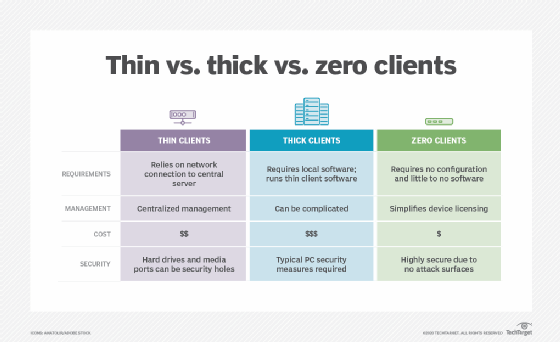
Benefits and drawbacks of zero client devices
The benefits of zero clients include the following:
- Power usage can be as low as one-fiftieth of thick client requirements.
- Devices are much less expensive than PCs or thin clients.
- It's an efficient and secure means of delivering applications to end users.
- No software on the client means that there is no vulnerability to malware.
- Administration is generally easy.
- In a virtual desktop environment, administrators can reduce the number of physical PCs or blades and run multiple virtual PCs on server-class hardware.
- Increased hardware efficiency can lead to improved user experience.
The drawbacks of zero clients include the following:
- They often have limited ability to render graphics.
- Performance depends on network connection because they rely on remote servers to do almost all processing.
- While some may be reconfigured, many zero clients are optimized for only one vendor or connection broker. At best, this is an inconvenience; at worst, it leads to vendor lock-in.
Zero client products in the market today
Vendors of zero client products include Digi International, VIA Labs and Dell Wyse.
Some examples of zero client products include the following:
- PD05 PCoIP zero client from EVGA
- 10ZiG 4648q Series zero clients
- Dell Wyse 5030 Zero Client
- LG Box Type Zero Client CBV42-BP
Each product may differ slightly in its price, I/O features and what protocol connection it's optimized for.
Zero clients are often used for VDI as they allow users to efficiently virtualize their desktop remotely on laptops, tablets and mobile devices.
Using zero clients for VDI
Zero clients are often used in VDI setups because of their unique benefits. They provide a traditional desktop experience without all the added maintenance, configuration and moving parts on the user's endpoint device.
Its lack of onboard storage and lack of OS gives hackers very few -- if any -- opportunities to access sensitive information and makes the device less likely to be exposed to a virus. Zero clients also have relatively quick boot-up times and require very little maintenance, which usually consists of simple firmware updates when necessary.
Additionally, zero clients can be remotely deployed and configured by IT administrators at scale because they are managed in a centralized computing infrastructure and do not require the IT worker to be in physical proximity to the device.
Users can load the virtual desktop on any endpoint, complete with personal preferences and configurations. This is convenient if an endpoint experiences maintenance issues because the user can use a different device to access the remote desktop and have an identical desktop experience.